
IMSI Catcher Detector: Professional IMEI & Stingray Detection
Fake cell towers can harvest your phone's identifiers, track your location, and in some setups intercept your communications. Our certified TSCM specialists detect IMSI catchers, Stingrays, and rogue base stations — confidentially, nationwide.
Is a Fake Cell Tower Listening to Your Phone?
IMSI catchers — also called IMEI catchers, Stingrays, cell-site simulators, or rogue base stations — impersonate legitimate cell towers to force nearby phones to connect to them. Once a phone connects, the device can harvest the phone's IMSI subscriber number and IMEI hardware identifier, pinpoint its location, and, depending on the configuration, capture communications content or metadata.
Bugged.com provides IMSI and IMEI catcher detection as part of professional TSCM and Cyber TSCM engagements, using spectrum analysis and cellular air-interface monitoring that consumer apps and low-cost gadgets cannot match. Call 866-292-3711 for a confidential assessment, or request a free quote. We are available 24/7, nationwide.
How an IMSI Catcher Performs a Man-in-the-Middle Attack
Phones are built to connect to the strongest, most attractive signal available. An IMSI catcher exploits that behavior by broadcasting as a cell tower, sitting invisibly between your phone and the real network.
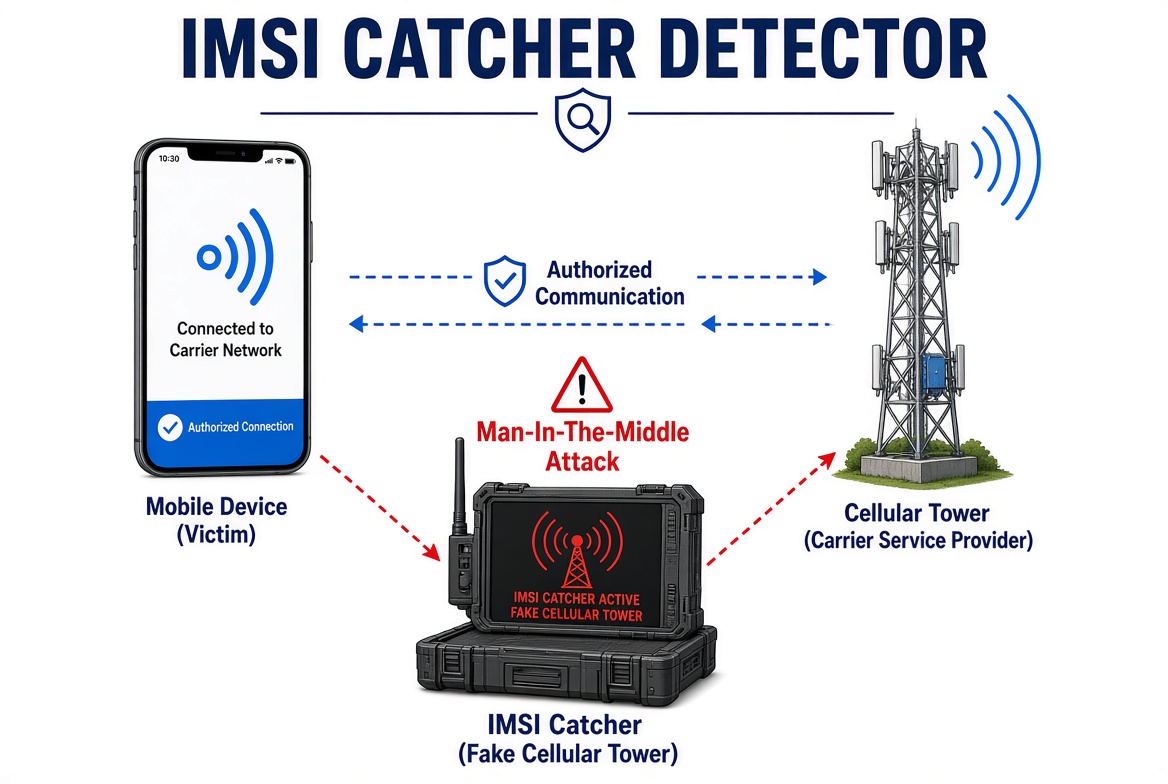
What Is an IMSI Catcher — and Why IMEI Matters
An IMSI catcher is a device that broadcasts as a fake cell tower. Because phones favor strong, convenient signals, the device attracts every compatible handset within range. Once connected, it can do a surprising amount.
Extract the IMSI
The International Mobile Subscriber Identity is tied to the SIM card and identifies the subscriber on the network.
Capture the IMEI
The International Mobile Equipment Identity belongs to the physical handset and does not change when the SIM does.
Track Location
Signal measurements allow a target's position to be tracked with high precision, in some cases in near real time.
Force Network Downgrades
Pushing a phone down to older, weaker 2G service removes protections that newer networks provide.
IMSI vs. IMEI: swapping your SIM card changes your IMSI, but the IMEI stays with the hardware. Advanced catchers log both, which allows a device to be tracked and correlated across SIM swaps and across locations. Many commercial systems are explicitly built as combined IMSI and IMEI catchers, which is why professional detection treats both identifiers as part of the threat.
These tools are used by law enforcement agencies, but they are also available to foreign intelligence services, criminal groups, and increasingly to private actors targeting businesses, executives, attorneys, and high-net-worth individuals.
Active vs. Passive IMSI Catchers
Not every cellular surveillance device behaves the same way, and each type leaves a different trace for a trained specialist to find.
Active IMSI Catchers
Active devices transmit and force connections. They can broadcast an attractive signal, extract identifiers, push phones to 2G or weaken encryption, intercept calls and texts in some configurations, and jam or disrupt service to isolate a target.
Passive IMSI Catchers
Passive devices primarily listen, transmitting little or nothing. They are harder to find by their radio emissions alone, but they still collect identifiers from normal network signaling and paging traffic.
Both modes leave forensic indicators. Professional TSCM teams look for them through air-interface analysis: unexpected cells, inconsistent area codes and cell parameters, unusual signal strength, unexplained downgrades, and geo-referenced signal mapping that exposes what does not belong in the local network.
What Professional Detection Actually Looks For
Your phone cannot see the cellular network the way a specialist can. It simply connects to whatever looks best. Real detection works by comparing what is present in the air around a location against what should be there, then examining every difference.
Unfamiliar Cells
Cell identifiers that do not appear in the carrier's known layout for that location and that have no legitimate reason to be there.
Inconsistent Parameters
Area codes, neighbor lists, and configuration values that do not line up with the surrounding legitimate towers.
Abnormal Signal Behavior
Signals that are unusually strong, appear suddenly, or do not match the physical position of a real tower.
Forced Downgrades
Phones pushed onto older network generations without a legitimate coverage reason, a common sign of an active device.
Context is everything. Networks change, carriers deploy temporary cells for large events, and coverage shifts with weather and construction, so a single odd reading is rarely conclusive. That is why a trained specialist measures repeatedly, across time and across locations, and interprets the results against the real network rather than reacting to one alert on one phone. The outcome is a confident answer you can act on, not a guess.
The Threat to Businesses and Individuals
A compromised cellular connection is not an abstract technical problem. It exposes the conversations and movements that matter most. Consumer-grade apps can flag some obvious anomalies, but sophisticated, short-duration, or passive deployments slip past them and leave you with a false sense of security.
Corporate & Industrial Espionage
Targeting of intellectual property, strategy, pricing, and client lists by competitors or foreign actors.
Executive Tracking
Following executives, board members, and key personnel to learn where they go and who they meet.
Privileged Conversations
Exposure of attorney-client communications, M&A discussions, and sensitive financial negotiations.
Device Correlation & Profiling
Linking a person's devices across locations to build detailed behavioral profiles over time.
Bugged.com's Professional IMSI & IMEI Catcher Detection
We integrate cellular surveillance detection into full TSCM and Cyber TSCM engagements rather than treating it as a single-gadget service. The goal is an expert-led answer, not a blinking light.
RF & Air-Interface Analysis
Spectrum analysis and cellular air-interface monitoring to identify unauthorized cells and anomalous signaling.
Rogue Base Station Detection
Identification of unexpected cells, jamming, and parameters that do not match the legitimate local network.
Geo-Referenced Mapping
Mapping cellular activity around facilities, vehicles, and meeting locations to show where anomalies originate.
Multi-Vector Coverage
The same engagement can address Wi-Fi, Bluetooth, GPS trackers, and traditional bugs, so no pathway is left unexamined.
Detection can be delivered as a standalone cellular surveillance assessment, built into a commercial, residential, meeting or boardroom, or vehicle sweep, or paired with cell phone forensics to examine individual devices.
What a Professional Detection Assessment Includes
On-Site Cellular Analysis
Assessment of the cellular environment at your office, residence, vehicle, or event location.
Active & Passive Indicators
Identification of the signs of both transmitting and listen-only devices.
Logged, Geo-Referenced Data
Real-time and recorded collection that supports findings with evidence.
Expert Interpretation
Specialists separate normal network behavior from genuine threats, which software alone cannot do.
Confidential Written Report
Clear findings, a risk assessment, and mitigation recommendations.
Rapid Response
24/7 availability for urgent situations, with options to combine with a full sweep.
Who Needs IMSI Catcher Detection?
Corporations
Organizations protecting trade secrets, M&A activity, and board-level discussions.
Executives & Attorneys
Professionals whose phone calls and movements carry privileged or market-moving information.
Sensitive Industries
Companies in competitive or geopolitically sensitive sectors where targeting is more likely.
Existing TSCM Clients
Clients already using Bugged.com who want cellular-specific coverage added to a sweep.
Some people come to us after noticing unexplained battery drain, sudden signal changes, or repeated drops to 2G service. Those symptoms have many innocent explanations and are not proof of an IMSI catcher on their own, but a pattern of them around sensitive events is a reasonable reason to have the environment professionally examined.
Does 5G Make IMSI Catchers Obsolete?
Not yet. 5G standalone networks improve protection by encrypting the subscriber identifier instead of sending it in the clear, which makes the classic IMSI-harvesting trick harder. But real-world protection depends on more than the standard itself: many 5G deployments still lean on 4G signaling, phones can be pushed back to older network generations, and passive collection and signaling weaknesses remain relevant.
As networks evolve, so do detection methods. Our specialists keep pace with changes in cellular protocols so that the assessment you receive reflects the networks your phones actually use today, not the ones from a decade ago.
Reducing Your Exposure Between Assessments
No personal habit replaces professional detection, but a few sensible practices limit what an interceptor can learn while you wait for an assessment or between engagements.
Use End-to-End Encrypted Calls & Messages
Encrypted apps protect the content of your conversations even if the cellular layer is compromised, although identifiers and location may still be exposed.
Disable 2G Where Supported
Some phones and carriers allow 2G to be switched off, which closes one of the most common downgrade paths.
Keep Software Updated
Operating system and baseband updates patch known weaknesses that cellular attacks rely on.
Move Sensitive Talks Off the Phone
For the most critical discussions, meet in person in a space that has been verified, rather than trusting any phone line.
If you are preparing for a high-stakes negotiation, board meeting, or off-site event, the most reliable approach is to verify the room and the cellular environment together. Explore our meeting and boardroom sweeps or ask about scheduling cellular detection ahead of a specific date.
A Standard Built on Three Decades of TSCM
For over thirty years, Bugged.com has led the field in technical surveillance countermeasures. Our founder, Michael Peros, and our specialists uncovered 65,000+ illegal intercepts in the Key Bank case — the largest documented illegal wiretapping case in U.S. history. We apply the same rigorous, multi-method discipline to modern cellular threats. Learn more about us and our TSCM methodology.
Cellular Detection Works Best as Part of a Full Sweep
Cellular surveillance is one pathway among many. Pair detection with the services below for complete coverage.
Cell Phone Forensics
Examine individual phones and devices for spyware, stalkerware, and remote-access tools.
Learn More →Cyber TSCM
Detect network-based surveillance across Wi-Fi, Bluetooth, and cellular environments.
Learn More →Commercial TSCM
Full corporate sweeps with cellular detection built in.
Learn More →Meeting & Boardroom Sweeps
Verify the cellular environment before sensitive meetings and events.
Learn More →Electronic Bug Sweeps
RF, NLJD, and network analysis for the full range of electronic threats.
Learn More →Our TSCM Methodology
See the layered process behind every Bugged.com sweep.
Learn More →IMSI Catcher Detection Questions Answered
What is the difference between an IMSI catcher and an IMEI catcher?
Most devices marketed as IMSI catchers also capture IMEI numbers. The IMSI identifies the SIM card and subscriber, while the IMEI identifies the physical handset. Advanced systems log both, which allows a target to be tracked even after the SIM card is swapped.
Is a Stingray the same thing as an IMSI catcher?
Stingray is a brand name that has become shorthand for a type of device called a cell-site simulator. IMSI catcher, Stingray, cell-site simulator, and rogue base station all describe equipment that impersonates a legitimate cell tower to make nearby phones connect to it.
Can apps or cheap hotspots reliably detect IMSI catchers?
They can flag some obvious anomalies, such as a sudden downgrade to 2G, but they miss short-duration, passive, or well-configured deployments and offer limited forensic value. A professional TSCM specialist using calibrated equipment and expert interpretation is required for high-stakes environments.
Do 5G networks eliminate the IMSI catcher threat?
No. 5G standalone networks improve protection by encrypting the subscriber identifier, but many 5G deployments still rely on 4G signaling, phones can be pushed to older network generations, and passive collection and signaling weaknesses remain relevant. Detection is still necessary.
How do I know if my phone is connected to an IMSI catcher?
Usually you cannot tell from the phone alone. Symptoms such as unexplained battery drain, sudden loss of signal, or a downgrade to 2G have many innocent causes. A professional assessment analyzes the cellular environment itself rather than relying on how a single phone behaves.
How quickly can Bugged.com respond?
We offer 24/7 rapid response nationwide. Call 866-292-3711 to discuss availability and the scope of your situation.
Is IMSI catcher detection confidential?
Yes. Every inquiry and engagement is handled with complete discretion, and assessments can be scheduled around your calendar, including evenings and weekends.
Can IMSI catcher detection be combined with a full bug sweep or phone forensics?
Yes. Most clients add cellular detection to a broader commercial, residential, meeting, or Cyber TSCM engagement, and cell phone forensics can be added to examine individual devices for spyware.
This page is informational and does not constitute legal advice. Laws governing cell-site simulators and interception vary by jurisdiction.
Don't wait for unexplained tracking to act.
Speak with a certified TSCM specialist about confidential IMSI and IMEI catcher detection. Free consultation, no obligation — nationwide coverage, complete discretion.
Trusted by 30,000+ clients · Certified TSCM · 100% Confidential